

Tena, Ecuador, October 2026
Since 2024, the project has been supporting four communities plant and maintain thousands of agroforestry trees. Carried out on the ground by partner organisation Ishpingo, it aims to restore degraded plots of land, while also providing farming families with new income opportunities from timber to fruit trees. Here’s a look back at a pivotal 2025, marked by the completion of planting and growth of young trees, as well as the emergence of an unexpected threat.
Reminder: two years of laying the groundwork
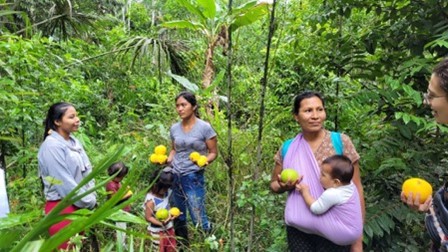
The project centres around four communities in the Tena basin: Machakuyaku, Yana Urku, and Kuyaloma, in Misahualli, as well as Sindy, on the other side of the Napo River, in Puerto Napo. In these villages, where people live mainly off selling cassava, bananas, cacao, and corn, families undertook to dedicate portions of their land to agroforestry.
In 2024, four community nurseries produced all the seedlings needed: 6,540 timber and 10,009 fruit trees, for a total of 16,549 trees. These seedlings were then distributed equally among the beneficiaries, and a first planting phase took place between October and December 2024: 11,962 trees were put in the ground by 57 families in Machakuyaku, Yana Urku, and Kuyaloma.
2025: planting comes full circle, monitoring takes hold
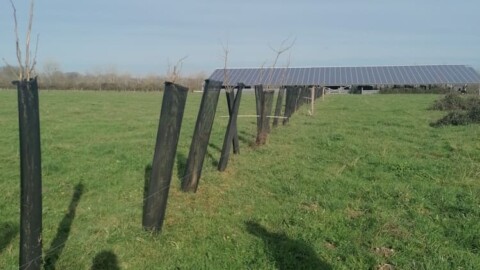
Right at the start of 2025, all the planned 16,549 trees were finally in the ground, among the project partner families, and GPS coordinates were recorded for every plot.
The rest of the year focused on technical monitoring, which is vital during the first few months of young trees. Between March and June 2025, technical teams visited the plots planted in late 2024, training farmers in shade management and crown reduction – practices that determine tree survival during their most fragile period.
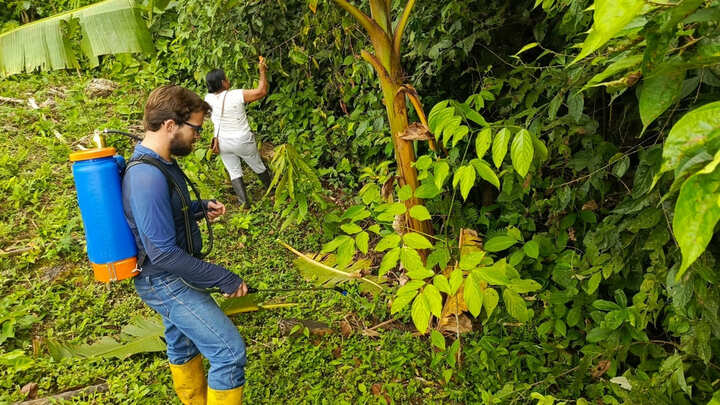
In the second half of the year, monitoring intensified with a second visit, about a year after planting: formative pruning of fruit trees to encourage strong branches and easier harvesting, pruning of timber trees to retain only the main stem, and applying an organic foliar fertiliser to support growth.
This second round of monitoring largely confirmed the plantations were in good health: in Kuyaloma, 92% of the plots had a survival rate of over 80%, and 58% even exceeded 90%. The few difficulties encountered remain limited to clay soils, poorly managed shade, ant attacks, and local drought, and are tackled with individualised support.
Sindy, a community under pressure
It was in Sindy that 2025 took a turn for the worse. The expanding of mining activities and illegal alluvial gold mining along the Napo River began to directly affect the community: four project beneficiaries gave in to financial pressure and sold their plots of land, which have since been destroyed and are difficult to access.
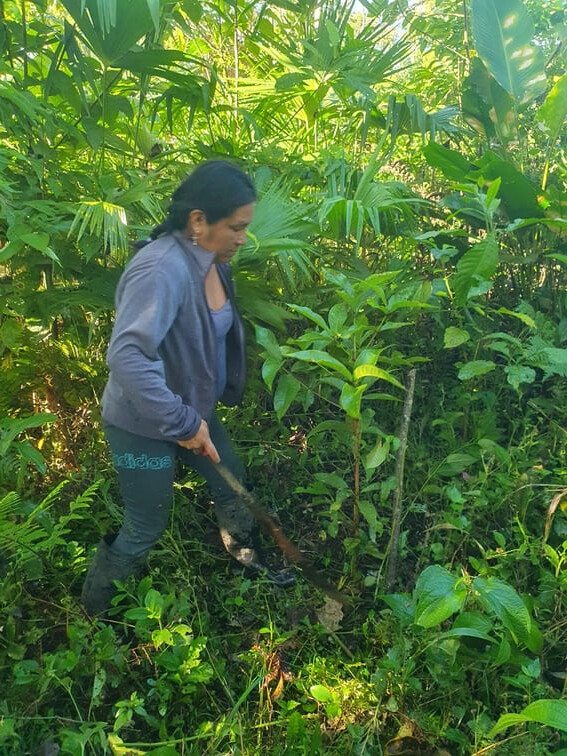
Despite this context, the 19 remaining plots in Sindy showed solid results, with 83% of them above 80% survival. A core group of long-standing beneficiaries, already involved in a previous planting season and who have since brought family members into the project, now represents the reforestation backbone of this community, where mining is a source of division. Field visits, both formal and informal, confirm the continued determination of these families to protect their land.
Looking ahead: consolidate, diversify, resist
The second annual monitoring round, completed in January 2026 for the last remaining plots, confirmed the project remains broadly on track, despite the losses in Sindy. The priority for 2026 is clear: a third monitoring round is planned for August 2026 on, across all plots, with special attention to supporting families in Sindy facing mining pressure.
Longer term, plans are underway to develop autonomous ‘aroma fino’ cacao nurseries. These will allow communities to sustainably diversify their income, and so reduce the temptation of short-term solutions like selling land for gold mining. For Ishpingo, and A Tree for You too, the challenge for the years ahead goes beyond tree growth alone: it is about establishing agroforestry systems that are sufficiently profitable and resilient that farming families in the Tena basin continue to choose the forest over mining.